How to read this: Maratua Resort is an independent concierge guide — we curate and compare dive resorts and island stays in the Derawan archipelago, then arrange your booking through a vetted operating partner. We do not own or operate the resorts, and resort or brand names are used only as neutral examples, not claims of affiliation. Prices are by quote and vary by resort, season and party; figures here are indicative. Flights, transfers and dive seasons change — confirm before you travel. This is general information, not a binding offer.
The best dive sites Maratua are its channel and wall dives along the atoll rim, especially the pelagic-heavy “Big Fish Country” and the famous barracuda tornado off the northern edge. Around these headline sites you’ll find a mix of high-energy current dives, gentler walls, and surprisingly good house-reef sites accessible from Maratua’s overwater resorts.
Maratua Resort is not a dive operator; we’re an independent guide and concierge for dive travel across the Derawan archipelago. This page is an editorial overview of how Maratua actually dives — the sites, conditions and experience level needed — so you can make sense of the marketing and plan a realistic trip.
—
What makes Maratua diving special
Maratua is a large, almost-enclosed coral atoll at the far southeastern edge of the Derawan archipelago in East Kalimantan, Indonesia. Most of the best diving happens along the outer atoll walls and channels, not inside the lagoon.
Several things make Maratua stand out in Borneo diving:
- Consistent current and pelagics. The atoll acts like a funnel, concentrating water flow through passes in the reef. Those currents — sometimes mild, sometimes very strong — are what bring in schools of barracuda, jacks and occasional sharks.
- The barracuda tornado. A resident school of chevron barracuda often forms a tight spiral — the “tornado” — at sites like Barracuda Point. It’s one of the signature big-fish experiences in Indonesia’s eastern Kalimantan region.
- Real wall diving. The outer reef drops quickly into deep blue water. Many dives start on a sloping reef and then follow a vertical or near-vertical wall, with whip corals, sea fans, and frequent mid-water life.
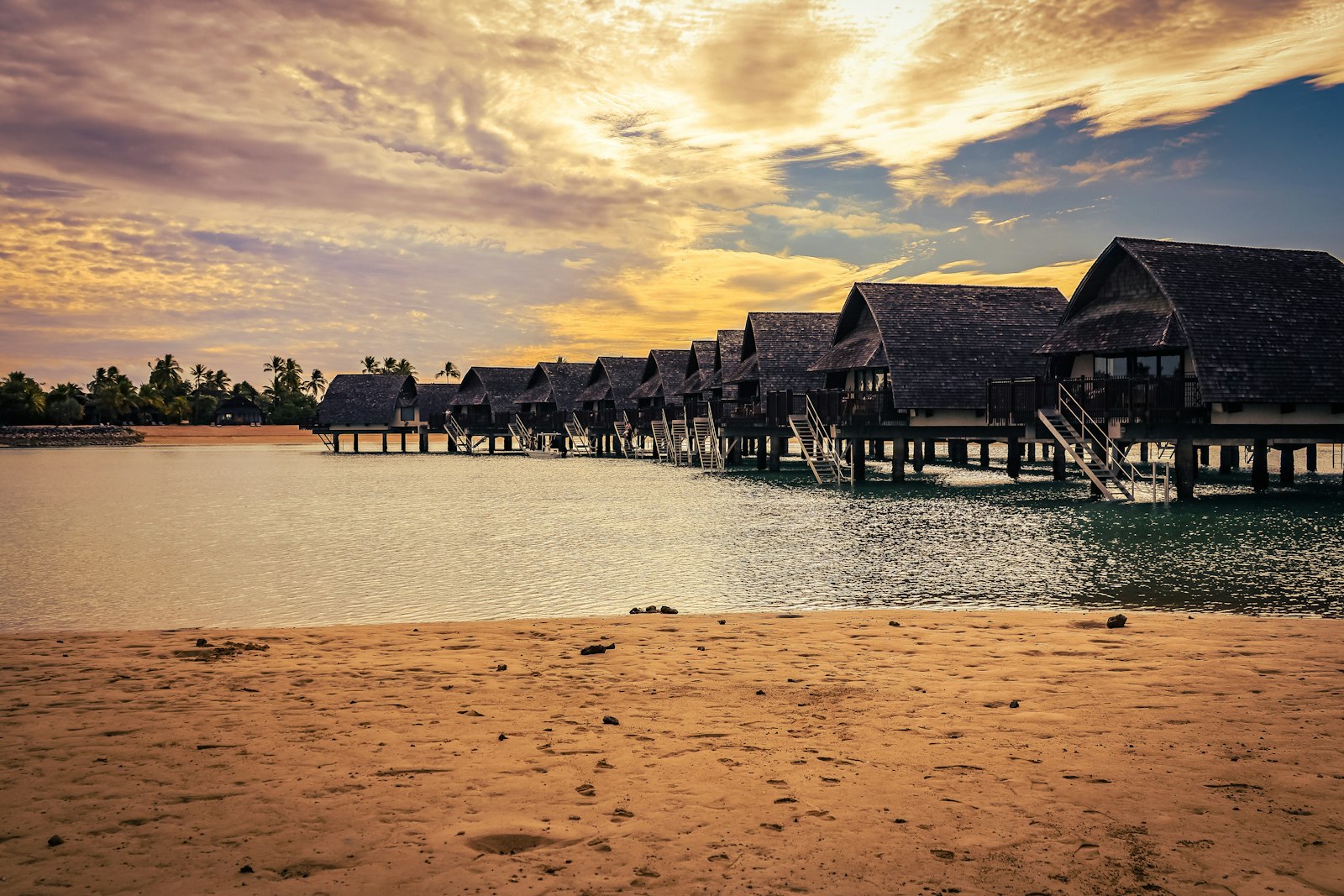
- Overwater resort access. Several Maratua accommodations are built over shallow lagoon water with easy house-reef access. That makes it possible to combine big current dives with relaxed, close-to-home house-reef exploration.
- Relative remoteness. Reaching Maratua usually involves a flight to Berau, road transfer to Tanjung Batu, and a boat ride out to the atoll. The upside: far fewer divers than more famous regions like Komodo or Raja Ampat.
Maratua rarely offers “perfect for everyone” conditions. The same currents that make the diving special also mean things can be demanding. This guide is written with that in mind: clear about what’s realistic, honest about where strong skills help a lot.
—
The barracuda tornado and Big Fish Country
Two phrases come up in almost any maratua dive site list: the “barracuda tornado” and Big Fish Country Maratua. Both refer to the kind of aggregated big-fish action that made the atoll well known among experienced divers.
Barracuda Point Maratua: understanding the tornado
“Barracuda Point” is a descriptive name more than a formal charted site. Depending on your resort or day-boat, you may hear slight variations, but they refer to a section of reef along the atoll edge where a large school of chevron barracuda often gathers in the current.
What to expect:
- The school itself. The barracuda often number in the hundreds. On good days they spiral into a tight column — the “tornado” — that you can slowly circle at a respectful distance. On other days they cruise as a looser school along the reef edge.
- Depth and position. Encounters typically happen between 15–25 m. Guides will usually aim to position the group slightly down-current of where the fish are expected to hold, then let the current bring you closer.
- Other life. Mixed in with the barracuda you’ll often see big-eye trevally, batfish, fusiliers and occasional grey reef or blacktip sharks in the blue. Turtles are common on the reef top.
Caveats:
- Wildlife is never guaranteed. Even a “resident” school shifts with conditions. Some dives, you may not see the tornado at all, or only as distant silvery flashes.
- Current can be serious. To have fish aggregations, you need moving water. On certain tides and moon phases the current here can be very strong and at times turbulent.
- Photographers need to be realistic. Hanging up-current of the school for the perfect shot is not always safe or acceptable to the guide. Expect to shoot with the flow, not against it.
Big Fish Country Maratua: what it actually is
“Big Fish Country Maratua” usually refers to the channel area on the eastern side of the atoll where water accelerates through a natural gap. It’s a classic atoll pass dive: you enter up-current, drift towards the throat of the channel, then hook in on the lip to watch the action.
Typical dive pattern:
- Negative or fast descent. To avoid being swept off the optimal line, many operators ask divers to descend quickly as a group. Buoyancy control from the first metres is important here.
- Drift towards the hook-in point. You’ll usually drift along a sloping reef with scattered coral heads. Look out for eagle rays, turtles, and hunting trevallies.
- Hook-in on the edge. At the channel lip, guides set the group up with reef hooks in areas of bare or dead rock. From there you hang in the blue watching schools of barracuda, jacks, and occasional sharks holding station in the current.
- Let go and continue the drift. Once gas or conditions dictate, you unhook, drift further into the channel and shallower reef, and eventually surface under an SMB.
Why it’s special:
- On good days this is Maratua’s signature pelagic dive, with serious volume of fish in motion — not only barracuda but also big-eye jacks, rainbow runners, and dogtooth tuna passing through.
- The sensation of hanging in the current with a reef hook, watching fish use the same water movement you’re fighting, is memorable and quite different from most reef drifts.
But again, this is not a “relaxing scenic tour” site. It’s a proper current dive requiring:
- Solid buoyancy and trim
- Comfort with negative entries (depending on operator and conditions)
- Ability to manage your own hook and stay in visual contact with the group
- Calm, controlled ascents and SMB use (or at least staying very close to a guide who deploys one)
If you want to base yourself on Maratua specifically to dive these sites, we can help you choose an operator and resort pairing that prioritises safety and realistic briefings. You can plan your trip with us or message our team on WhatsApp at +62 811 3823 875 for tailored advice.
—
Wall and channel sites around Maratua Atoll
Beyond the headline names, the atoll offers a network of walls, slopes and smaller channels. Each operator uses slightly different site names, and exact mooring locations may vary, but the underlying reef structures are broadly similar.
Here’s a functional way to think about the main types of Maratua dive site list entries, without getting hung up on brand-specific labels.
Outer wall dives
These are the backbone of Maratua diving: steep walls or drop-offs along the ocean-facing rim of the atoll. Key characteristics:
- Topography. Reef usually starts shallower than 10 m with coral gardens and bommies, then drops off into deep blue. Walls can be vertical or stepped with ledges and overhangs.
- Currents. Often mild to moderate; occasionally strong depending on tides and exact position relative to passes.
- Marine life. Mix of schooling fusiliers, surgeonfish, snappers, and the occasional pelagic cruise-by. Green and hawksbill turtles are frequent. Macro life — nudibranchs, shrimps, small crabs — rewards slow lookers, especially on more sheltered sections.
- Depth range. Many divers spend most of the time between 15–25 m, with safety stops on the sloping top or reef flat.
These sites are often used for a first-day orientation dive or for mixed groups, because they can be adapted to varying skill levels. Guides can run sections as easy drifts or add a bit of challenge by crossing minor currents.
Secondary channels and corner sites
Beyond the headline Maratua channel dive at Big Fish Country, there are smaller passes and corners where water accelerates and fish aggregate.
Common patterns:
- Corner points. Where the outer reef turns a corner, you often get an up-current side and a more sheltered lee side. Guides may position groups on the up-current edge to watch for pelagics, then drift around the corner onto a calmer reef.
- Mini-pass dives. Small gaps in the reef can behave like scaled-down versions of Big Fish Country: faster water in one section, sandier channels and bommies inside.
Fish life can be excellent on these sites: schooling snappers, barracuda (smaller groups than at Barracuda Point), and often healthy sponges and fans that benefit from consistent water flow.
Skill-wise, these dives sit between the easy walls and the strongest channel dives. They’re often where intermediate divers can start to learn current-reading and hook use under supervision.
Lagoon and interior reef sites
Inside Maratua’s lagoon the reef is generally shallower and more protected. Visibility can be more variable here, particularly after rain, and coral cover may not match the outer wall. But these interior sites have their uses:
- Training and check dives. Calmer water makes it easier for instructors to run skills.
- Macro and critter focus. With less water movement and more sediment, some lagoon areas attract a different community of small life — gobies, pipefish, juvenile reef fish.
- Weather contingencies. On days when wind or swell makes outer sites uncomfortable, lagoon reefs can keep diving possible.
These are rarely the reason divers travel to Maratua, but they fill important gaps in a week-long schedule and can be better than their reputation suggests, especially if you enjoy macro.
—
House-reef diving on Maratua
One of Maratua’s practical advantages is that several accommodations sit right over the water with house-reef access directly from a jetty or short boat hop. Each property’s reef section differs, but some general patterns hold.
What Maratua house reefs are like
Most house reefs share a similar profile:
- Shallow lagoon or reef flat (2–6 m). Sandy patches, scattered coral heads, seagrass in places. Good for long, slow dives and for photographers who like to take their time.
- Gentle slope to 15–20+ m. More continuous coral cover, small bommies, and in some areas, access to the top of a wall that then drops deeper.
- Variable current. Depending on the position relative to channels and the tide, house reefs can be calm or have a steady, manageable drift. Rarely as intense as outer channels, but not always completely still.
Marine life expectations:
- Everyday reef life. Damselfish, butterflyfish, small wrasses, anthias, and juvenile fish sheltering in branching corals.
- Turtles. Lagoon turtles often graze on seagrass or rest under ledges on the slope.
- Macro. With enough slow dives and good spotting, you can find nudibranchs, shrimps, and occasional octopus or cuttlefish, especially on dusk or night dives.
- Occasional surprises. Eagle rays or small reef sharks sometimes pass through, particularly along deeper sections of the slope.
Why house-reef dives matter in Maratua
Given the atoll’s strong currents and boat logistics, house-reef access is not just a bonus; it can be central to a relaxed trip:
- Flexible schedules. You can add an unguided or lightly guided afternoon dive without committing a boat and full crew, depending on the resort’s rules and your certification.
- Skill-building. Intermediate divers can solidify buoyancy and trim on relatively forgiving terrain before tackling stronger current sites.
- Night diving. Many of Maratua’s outer sites are not suitable for night dives due to exposure and navigation complexity. House reefs often offer the safest, most practical night-dive setting.
If spending a lot of time on a house reef appeals to you, we can help match you to properties with the most interesting accessible sections and realistic policies on self-guided diving. Plan your trip with us or message +62 811 3823 875 on WhatsApp to discuss options.
—
Skill level, currents and safety
Maratua’s reputation for big fish is tied directly to its currents. Those currents demand respect from divers and operators alike.
Who Maratua diving is best for
As a broad guideline:
- Ideal: Divers with Advanced Open Water (or equivalent) and at least 40–50 logged dives, including experience in mild to moderate currents.
- Comfortable but selective: Newly advanced divers with ~25–40 dives, if they are willing to skip the strongest channel dives or build up gradually.
- Not ideal for first-ever dives. Discover Scuba or very early Open Water dives are better done in calmer, more predictable environments than the outer atoll edge.
Certifications that help:
- Advanced / 30 m certification. Many of the best encounters sit naturally between 20–30 m.
- Drift specialty. Even if not formally certified, any prior guided experience of proper drift diving and SMB use is extremely beneficial.
Current patterns you can expect
Current behaviour around an atoll is complex and influenced by tides, moon phase, and winds, but some patterns recur:
- Flood and ebb through passes. Water rushing into or out of the lagoon concentrates in channels like Big Fish Country, producing strong horizontal flow and sometimes vertical components.
- Corner accelerations. Where the reef bends, currents can speed up, change direction or create eddies.
- Lulls and layers. Even on “strong current” dives, there are often partial shelter zones behind bommies or on the lee side of ridges. A good guide will use these to brief and reposition the group.
None of this is a reason to avoid Maratua, but it is a reason to be candid:
- Not every dive will be comfortable for every diver. It is normal — and sensible — to sit out the odd dive that exceeds your comfort level.
- Conditions change quickly. A site that is gentle on one tide can be challenging a few hours later.
- Guides vary. Different operators have different standards for maximum group size, negative entries, and hook use. This matters in current-heavy areas.
Practical safety tips for Maratua
If you decide to dive Maratua’s best sites, some simple practices go a long way:
- Be honest in your pre-dive form. Understating your number of dives or comfort level helps no one.
- Carry a DSMB. A surface marker buoy and the ability to deploy it are important in any drift environment. If you’re not comfortable with deployment, ask for a dedicated briefing or practice in calm water.
- Use reef hooks correctly. Only hook into dead rock or rubble, never into living coral or sponges. Keep your profile low and hose routing tidy to reduce drag.
- Stay in sight of a guide. In strong current, even small separations can turn into large gaps quickly.
- Conserve gas early. Negative entries and quick descents burn gas. Relax your breathing as soon as you’re at planned depth.
If you’d like a frank assessment of whether Maratua’s typical conditions are a good match for your experience, we’re happy to talk specifics. You can plan your trip via our enquiry form or send us your certifications and logged-dive profile on WhatsApp at +62 811 3823 875 for personalised guidance.
—
At-a-glance: Maratua’s core dive styles
Below is a simplified comparison of the core types of Maratua dives discussed above. Exact details vary site by site and operator by operator, but this gives a realistic framework.
| Type | Typical Depth | Current | Highlights | Recommended Experience |
|---|---|---|---|---|
| Outer wall dives | 15–25 m (reef top from ~8 m) | Mild to moderate; occasionally stronger on corners | Vertical drop-offs, turtles, schools of reef fish, occasional pelagics | Certified Open Water; 15–20+ dives recommended |
| Major channel dives (e.g. Big Fish Country) | 18–30 m (safety stop on reef top) | Strong to very strong; hook-in dives common | Barracuda, jacks, tuna, sharks in the blue; high-energy drifts | Advanced / 30 m; confident in current with ~40–50+ dives |
| Secondary channels & corners | 15–25 m | Moderate to strong; variable with tide | Fish aggregations, eagle rays, healthy sponges & sea fans | Advanced or experienced Open Water with prior drifts |
| Lagoon / interior reefs | 5–18 m | Generally mild, can be tidal | Macro, juveniles, training-friendly topography | All levels, including training dives |
| House reefs | 5–20 m | Mild to moderate; site- and tide-dependent | Long, slow dives, macro, turtles, convenient access | From recent Open Water to advanced, depending on policies |
—
Planning your Maratua dive trip
Maratua Resort exists to help divers navigate the gap between generic booking sites and individual operator marketing. We do not run boats or own a dive centre; instead we:
- Curate and compare resorts and dive operators across Maratua and the wider Derawan archipelago.
- Match your experience and priorities — big fish, photography, gentler diving, or a mix — to realistic site access and schedules.
- Route confirmed enquiries to a vetted local operating partner. No one can pay to change what we publish; if you proceed with our partner they may pay us a referral fee at no extra cost to you.
For a deeper overview of the region’s diving as a whole, see our main Derawan & Maratua diving guide, and if you’re comparing places to stay, our Maratua dive resort guide outlines the main options and trade-offs.
To get specific — dates, experience level, realistic expectations for Big Fish Country or Barracuda Point, resort pros and cons — plan your trip with us or message +62 811 3823 875 on WhatsApp. A short, honest conversation at this stage usually leads to better dives and fewer surprises on arrival.
—
Is Maratua suitable for beginner divers?
Parts of Maratua are accessible to newer divers, especially house reefs and calmer lagoon or outer-wall sections on gentle tides. However, the headline sites such as Big Fish Country and the strongest channel dives are not beginner-friendly. If you have fewer than 20 dives, expect to focus on easier reefs and use the trip as a step towards more advanced current diving later.
Can I guarantee seeing the barracuda tornado at Barracuda Point Maratua?
No. The barracuda school is resident but not fixed in place, and its behaviour changes with current, visibility and other factors. On many trips divers do see the tornado effect; on some dives the fish may be absent, deeper, or less tightly grouped. Any operator claiming guaranteed sightings is overselling; treat the tornado as a strong possibility, not a promise.
What certification do I need for Big Fish Country Maratua?
Most responsible operators require at least Advanced Open Water (or equivalent) and solid recent experience in current for Big Fish Country. A 30 m depth rating is useful, and prior drift or reef-hook experience makes the dive more enjoyable and safer. Even with the right card, a good guide may still ask you to build up with easier sites first.
Are there good non-current dives in Maratua?
Yes, though “non-current” is relative. Interior lagoon sites, some house reefs, and parts of the outer wall on the right tide can offer mild, manageable water movement with plenty of life. These are often used for check dives, macro-focused dives and photography sessions where stability matters more than big-fish volume.
How does Maratua compare to Sangalaki and Kakaban for diving?
Maratua is strongest on walls, channels and big-fish current dives. Sangalaki is about manta encounters and sandier reefs; Kakaban is famous for its non-stinging jellyfish lake and has some excellent nearby walls and drop-offs. Many itineraries sensibly combine all three areas so you get pelagics, mantas and unique topside experiences in one trip.