
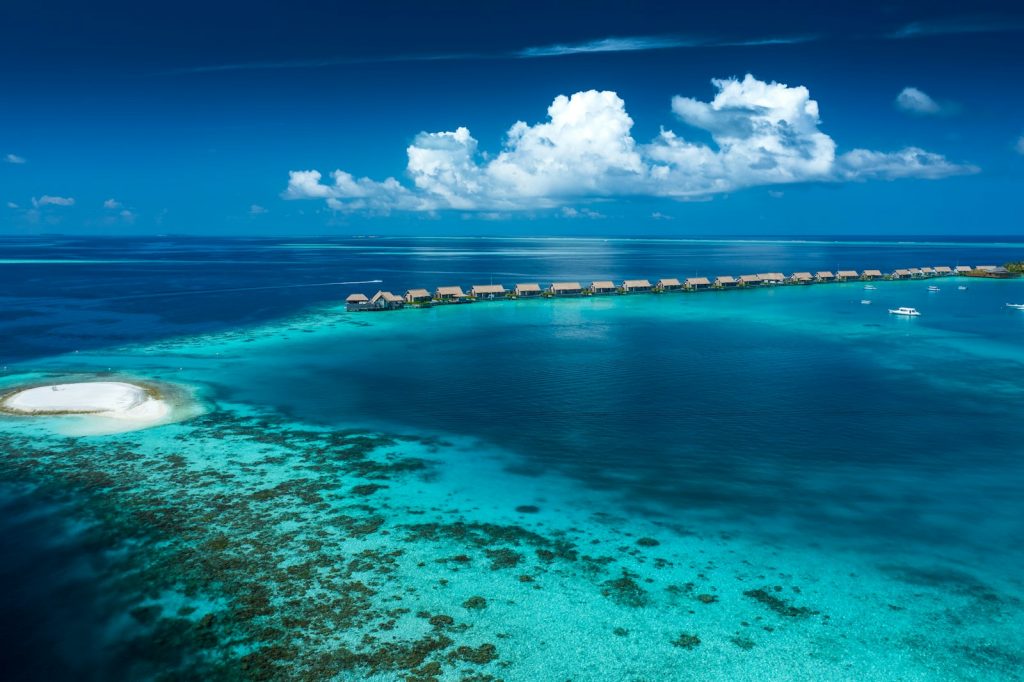
How to read this: Maratua Resort is an independent concierge guide — we curate and compare dive resorts and island stays in the Derawan archipelago, then arrange your booking through a vetted operating partner. We do not own or operate the resorts, and resort or brand names are used only as neutral examples, not claims of affiliation. Prices are by quote and vary by resort, season and party; figures here are indicative. Flights, transfers and dive seasons change — confirm before you travel. This is general information, not a binding offer.
Derawan island hopping is the classic way to link Derawan, Kakaban, Sangalaki and Maratua by speedboat in a single trip, combining turtles, mantas, jellyfish lake and walls. It is not one fixed tour, but a flexible route structure that good operators adapt to sea conditions, your budget, and how much time you have.
What a Derawan island-hopping trip actually covers
Most people using the phrase “Derawan island hopping” are talking about a speedboat-based circuit of four main islands in the Derawan archipelago:
- Derawan – village island, high turtle density, easy snorkelling and compact house reefs.
- Sangalaki – manta ray cleaning stations, often combined with turtle hatchery visits.
- Kakaban – famous non-stinging jellyfish lake plus outer reef drop-offs.
- Maratua – larger atoll with deep walls, currents and more “remote” resort options.
Operators then build either a Derawan–Maratua–Kakaban–Sangalaki loop, or a Derawan-based day-trip pattern, using private or shared speedboats. Transfers between any two of the main islands typically take 30–60+ minutes depending on boat size and sea state.
A few key definitions:
- A Derawan Maratua Kakaban Sangalaki tour is usually a marketing label for this four-island loop, offered as packages ranging from 3D2N (three days, two nights) up to one week or more.
- A Derawan 3D2N package almost always includes at least one long day by boat visiting Kakaban and Sangalaki, sometimes a touch of Maratua, and one shorter day around Derawan itself.
- A Derawan islands tour can be anything from a half-day turtle snorkel to a multi-island circuit; always check which islands are actually included.
At Maratua Resort we do not operate boats or run group tours ourselves. Our role is editorial and concierge: we compare resorts and operators across the islands, and then route serious enquiries to a single vetted partner operator who can quote and run the trip. No one can pay to change what we publish; if you proceed with our partner they may pay us a referral fee at no extra cost to you.
The classic four-island route – and what each island delivers
The most efficient island hopping Derawan itinerary connects the four core islands in a sequence that respects both distance and the character of each site.
1. Derawan – easy turtles and village life
Role in the itinerary:
Common start and end point, thanks to its proximity to Berau’s ports and the availability of simple guesthouses and mid-range lodges.
What Derawan adds to a loop:
- High turtle encounters: Green turtles patrol the shallows; you’ll often see them straight off the jetty or house reef.
- Gentle introduction to the archipelago: Calm, shallow water and easy entries suit first-day snorkelling, check dives and those just off a long transit.
- Village feel: Wooden walkways, warungs, homestays and small shops; more local life than the other three islands.
Who benefits most from Derawan nights:
- Travellers on tighter budgets wanting homestays or simpler rooms.
- Groups with non-divers who enjoy walking the village, sitting on jetties, short snorkels.
- Anyone arriving late day into Berau (Tanjung Redeb / Tanjung Batu) and needing an accessible first stop.
2. Sangalaki – mantas (in season) and turtle conservation
Role in the itinerary:
Usually a half- or full-day destination by speedboat from either Derawan or Maratua, not a primary place to sleep (accommodation is limited and typically used by specialist groups).
What Sangalaki delivers:
- Manta ray cleaning and feeding stations: On the right tides and seasons you may see mantas circling in relatively shallow water. They are never guaranteed, but this is the main reason Sangalaki is on the map.
- Snorkelling as well as diving: Mantas sometimes come close enough for snorkellers when conditions align.
- Turtles on the beach: Various operators coordinate visits around turtle nesting and hatchery activities, handled under local guidelines.
Positioning within the route:
- Accessible in roughly 45–75 minutes by speedboat from Derawan, depending on boat and sea.
- Often combined with Kakaban on the same long day to maximise boat time (for example: Derawan → Kakaban jellyfish lake → Kakaban outer reef → Sangalaki mantas → Derawan).
3. Kakaban – jellyfish lake and outer walls
Role in the itinerary:
The non-negotiable stop on nearly every Derawan islands tour. The jellyfish lake is unique in Indonesia and a central reason many travellers come.
What Kakaban delivers:
- Jellyfish lake experience: A brackish lake inside the island, accessed via a short boardwalk. You float with non-stinging jellyfish that have evolved in isolation. Snorkelling only, no fins in the lake to protect the environment; specific rules may vary slightly by local management and change over time.
- Adventurous feel: The lake visit involves a bit of walking and basic facilities; it is more “nature park” than manicured resort excursion.
- Outer reef and wall dives: Outside the lagoon, Kakaban’s walls and drop-offs offer schooling fish, occasional pelagics and healthy coral slopes. Several named dive sites wrap around the island; your operator chooses based on conditions and your certification level.
Transfer times and sequencing:
- Typically 30–60+ minutes by speedboat from either Maratua or Derawan in workable seas.
- Pairs well with Sangalaki in one extended loop day, or with Maratua walls on a diving-focused itinerary.
For details on the lake rules, practicalities and environmental context, see our dedicated guide: Kakaban jellyfish lake.
4. Maratua – walls, channels and a more remote feel
Role in the itinerary:
Maratua is both a destination and a base. Many higher-end dive resorts and dedicated dive packages cluster here, with house reefs and jetty access to deeper walls.
What Maratua contributes:
- Deeper walls and channels: This is where most experienced divers focus their time: walls, drifts and, at some sites, schooling barracuda and seasonal sharks, all subject to currents and visibility.
- Quieter, more removed environment: Compared to Derawan village, Maratua feels more like an atoll with standalone resorts and smaller local communities.
- Logical dive base: If your priority is diving rather than general sightseeing, a Maratua-based Derawan dive package with day trips outward to Kakaban and Sangalaki can be more efficient.
Transfer logic:
- From the mainland (Tanjung Batu or nearby ports) to Maratua, you’re looking at a longer private or scheduled speedboat ride, usually around 1.5–3 hours depending on the exact departure point, boat and conditions.
- Maratua to Kakaban is one of the shorter “hops”; Maratua to Sangalaki is longer and usually packaged as a special trip or combined loop.
If you know you want a dive-first trip, it’s worth reading our deeper comparison of dive-focused options and packages here: Derawan dive package.
How operators connect the four islands by speedboat
No single “official” route exists. Each operator adjusts based on:
- Sea conditions and forecast winds.
- Your entry and exit points (e.g. Berau flights, Tarakan, or base on Maratua).
- Diving vs snorkelling focus.
- Budget (private boats vs joining shared trips).
That said, a few patterns repeat.
Common routing patterns
-
Derawan day-trip hub
– Sleep 2–3 nights on Derawan.
– Day 1: Derawan house reef and turtle snorkelling.
– Day 2: Full-day boat to Kakaban and Sangalaki (possibly touching Maratua channel sites for divers).
– Optional Day 3+: Additional Derawan local dives or repeat Kakaban/Sangalaki if budget allows. -
Maratua dive hub with satellite trips
– Sleep 4–7 nights on Maratua.
– Most days focused on Maratua walls, channels and nearby reefs.
– One or two long days by speedboat to Kakaban jellyfish lake plus outer dive sites; optionally Sangalaki on a separate day.
– Derawan village sometimes skipped entirely or used only as a transit stop. -
Linear A→B run (for those changing bases)
– Arrive from mainland to Derawan, sleep 1–2 nights.
– Then move by speedboat along the arc Derawan → Sangalaki → Kakaban → Maratua, using one or two full days to visit islands en route before being dropped at a Maratua resort.
– Final day return from Maratua direct to mainland, skipping Derawan on the way back.
Transfer times – realistic expectations
Sea states inside the archipelago can shift quickly with wind and tide, and boat speeds vary. Treat these as broad ranges rather than promises:
- Derawan → Sangalaki
- Around 45–75+ minutes by speedboat.
- Derawan → Kakaban
- Often 45–60+ minutes, depending on sea and route.
- Maratua → Kakaban
- Commonly around 30–45+ minutes.
- Maratua → Sangalaki
- Often 60–90+ minutes; usually done as a dedicated full-day trip.
- Mainland (Tanjung Batu area) → Derawan
- Roughly 30–60+ minutes by speedboat.
- Mainland → Maratua
- Commonly 1.5–3 hours; expect earlier departures and some flexibility.
Operators reserve the right to cancel or reroute if seas are unsafe. Any good Derawan Maratua Kakaban Sangalaki tour will frame its daily route as “planned” rather than “guaranteed” and adapt to real conditions on the water.
For a step-by-step overview of how to reach the region itself, see our separate transport primer: how to get to Derawan.
Sample Derawan island-hopping itineraries: 3D2N and 4D3N
Packages in this region use shorthand like “3D2N” (three days, two nights) or “4D3N” (four days, three nights). These are time frames, not fixed inclusions. Two operators can both sell “Derawan 3D2N package” and offer completely different actual experiences.
Below are realistic example flows to calibrate your expectations. Treat them as templates your operator can modify.
Example 3D2N Derawan-based itinerary (mixed snorkel and sightseeing)
Who this fits:
First-time visitors with limited leave; mixed groups with non-divers; those happy to be a bit rushed for the sake of seeing several islands.
Day 1 – Arrival and Derawan turtles
- Morning or early afternoon arrival in Berau, transfer to harbour, speedboat to Derawan (timing depends on flights and operator).
- Check-in at a Derawan guesthouse or mid-range lodge.
- Late-afternoon turtle snorkel on the house reef or from a nearby jetty.
- Simple dinner in the village.
Day 2 – Kakaban jellyfish lake and Sangalaki loop
- Full-day shared or private speedboat, usually starting early.
- First stop: Kakaban jellyfish lake. Walk over the boardwalk, snorkel with the jellyfish under local rules.
- Optional outer reef snorkel or dive at Kakaban, conditions permitting.
- Second stop: Sangalaki for manta search (snorkel and/or dive) and possible turtle-related conservation visit managed by local authorities.
- Return to Derawan before or just after sunset, depending on distance and sea state.
Day 3 – Derawan village time and departure
- Short morning snorkel or relaxed walk around the village.
- Midday or early afternoon boat back to the mainland and overland transfer to the airport, shaped by your flight time.
This is the minimum format that still meaningfully touches the four-island concept. Maratua may appear only as a distant atoll on the horizon, or as a quick deeper-water dive site if group composition and conditions allow.
Example 4D3N with a night on Maratua (more dive-oriented)
Who this fits:
Divers with at least Advanced Open Water or equivalent looking to see both walls and big animals, while still visiting the jellyfish lake.
Day 1 – Mainland → Derawan; check dive
- Transfer to Derawan, settle into accommodation.
- One afternoon check dive or snorkel on the Derawan house reef (turtles, schooling fish, macro subjects).
- Briefing for the next days’ offshore runs.
Day 2 – Derawan → Kakaban → Sangalaki → Maratua
- Early departure by private speedboat.
- Kakaban jellyfish lake in the morning before crowds, plus one outer reef dive or snorkel.
- Sangalaki mid-day searching for mantas at cleaning or feeding sites, tailored to tides.
- Late-afternoon move onwards to Maratua, arriving near sunset and checking into a resort.
Day 3 – Maratua walls and channels
- Two or three dives on Maratua’s walls, reefs or channels, chosen based on currents and your experience.
- Non-divers can snorkel off the jetty or take a paddle, depending on the resort’s facilities.
- Quiet evening at the resort.
Day 4 – Optional morning dive and departure
- Optional morning dive or snorkel if your flight schedule allows adequate surface interval.
- Midday or early afternoon boat back to mainland and land transfer onward.
Staying one or more nights on Maratua changes the feel of your Derawan islands tour significantly: less time bouncing on boats, more time diving and sleeping by deeper water.
Longer stays: 5–7 nights
Once you cross the four-night mark, it makes sense to anchor yourself primarily on either Derawan or Maratua and treat the other islands as day excursions.
A common split:
- 1–2 nights on Derawan for village life and turtles.
- 3–5 nights on Maratua focusing on diving, with one full day to Kakaban and Sangalaki layered into the middle of the stay to avoid fatigue.
To map a realistic multi-day flow with your arrival flights and preferred balance of diving vs snorkelling, you can plan your trip with our help or message us on WhatsApp at +62 811 3823 875. We’ll suggest a structure and pass the brief to a vetted local operator for a detailed quote.
Choosing a base: Derawan vs Maratua
One of the most useful planning decisions you can make early: which island should be your main base? You do not need to sleep on all four; in fact, most travellers split their time between just one or two.
Here’s a neutral comparison.
| Aspect | Derawan | Maratua |
|---|---|---|
| Overall feel | Village island; more local life, jetties, homestays, small eateries. | Atoll with stand-alone resorts; quieter and more “retreat-like”. |
| Access from mainland | Generally shorter speedboat ride from ports near Berau. | Longer ride; some scheduled transfers tied to specific resorts. |
| Best for | Budget-friendly stays, first-time snorkellers, mixed-interest groups. | Dedicated dive trips, longer stays, those prioritising quieter nights. |
| Core marine highlight | Abundant turtles close to shore; gentle house reefs. | Deep walls, channels and stronger-current dives. |
| Day-trip options | Good launch point for Kakaban & Sangalaki, sometimes Maratua in one long loop. | Regular trips to Kakaban; Sangalaki typically as a longer, special excursion. |
| Non-diver appeal | Walking the village, short snorkels, sitting on jetties at sunset. | Relaxing by the water, fewer “in-village” distractions. |
| Budget range (last verified June 2026) | From simple homestays up to mid-range lodges. | Mainly mid-range to higher-end dive resorts. |
In practice:
- Choose Derawan as your main base if:
- You’re on a tighter budget and comfortable joining shared boats.
- You want a more social, village environment.
-
You’re mostly snorkelling, with diving as an add-on rather than the core reason for the trip.
-
Choose Maratua as your main base if:
- Diving is your primary goal and you want easy access to deeper sites.
- You prefer to minimise long day-trip commutes by having more diving right outside the resort.
- You’re staying 5 nights or more and prefer a quieter setting.
Many travellers split the difference: 2 nights on Derawan + 3–5 nights on Maratua, with Kakaban and Sangalaki woven into the transfers between them.
How Derawan island-hopping packages are structured and quoted
No two operators package exactly the same way, but some patterns are common across the region.
What “packages” usually include
A typical Derawan Maratua Kakaban Sangalaki tour quote will bundle some or all of:
- Accommodation: Room type, occupancy, and meal plan (from simple breakfast-only to full board at dive resorts).
- Speedboat transfers:
- Mainland → base island (Derawan or Maratua).
- Day-trip boats between islands (Kakaban, Sangalaki, potentially Maratua if you’re based on Derawan).
- Base island → mainland at the end.
- Marine activities:
- For snorkellers: masks, snorkel, fins sometimes included, with guiding.
- For divers: tank, weights, guide; sometimes full gear rental at extra cost.
- Park or conservation fees:
- Entry fees for Kakaban jellyfish lake, Sangalaki and other protected areas, which can change year to year.
- Land transfers:
- Airport to harbour and back.
- Sometimes an overnight on the mainland if your flight schedule requires it.
Clarify, in writing, how many actual hours at each key island you are likely to have, and how many dives or guided snorkels are included vs optional extras.
Price ranges (indicative only)
Exact numbers fluctuate with fuel prices, exchange rates and local fee structures. As of last verified June 2026, common patterns are:
- Short Derawan-based 3D2N packages (snorkel-focused, simple accommodation):
- Usually priced per person based on 2–4 people sharing a boat and room, with solo travellers paying more.
-
Expect a significant jump if you request a fully private speedboat for your group.
-
Longer 4D3N to 7D6N dive packages ex-Maratau:
- Typically per-person rates assuming double occupancy and a minimum number of divers.
- Supplements apply for single rooms, private guiding, nitrox, or special long-range trips to Sangalaki.
Because we do not operate boats ourselves, we don’t publish single fixed prices. Instead, we:
- Help you choose a realistic route and base island for your dates and priorities.
- Translate that into a trip brief (number of nights, diving vs snorkelling days, preferred comfort level).
- Pass it to a vetted local partner operator who can provide an itemised quote, including any current conservation fees.
For a ballpark cost range tailored to your group size and style, you can review how Derawan tour package price structures work, then plan your trip with us or message via WhatsApp at +62 811 3823 875.
Questions to ask before you book
To keep your derawan island hopping plan realistic and avoid surprises, ask your operator:
- Boat type and safety:
- What size and type of speedboat will we use?
- Is there a canopy? Lifejackets for every passenger? Radio or phone contact?
- Group size:
- Maximum guests per boat?
- Is this a private charter for my group or a mixed-party shared trip?
- Flexibility for weather:
- What happens if the sea is too rough to reach Kakaban or Sangalaki on the planned day?
- Are there backup sites or alternative dates within your stay?
- Diving details (if relevant):
- Maximum depth limits, required certifications, and how they assign groups by experience.
- Gear rental costs and what brands/sizes are available.
- Conservation practices:
- How do they brief guests around mantas, turtles and the jellyfish lake?
- Do they limit group size in the lake or maintain minimum distances from mantas?
The more specific your questions, the easier it is for a serious operator to show that they are thinking about safety and environmental impact, not just sightseeing.
How we can help you plan Derawan island hopping
As Maratua Resort’s Logistics & Access desk, our role is to help you make sense of the options across Derawan, Maratua, Kakaban and Sangalaki, then connect you to one trusted operator who can actually run the trip on the water.
We can help you:
- Decide Derawan vs Maratua as a base (or a split) based on your flights, budget and diving/snorkelling mix.
- Sequence a realistic 3D2N, 4D3N or longer island-hopping flow that doesn’t spend half your holiday just transiting.
- Understand how your arrival and departure days affect what you can see without stressing your safety or surface interval windows.
We stay neutral in our editorial coverage: no one can pay to change what we publish. If you like the structure we propose and choose to book via our vetted partner, they may pay us a referral fee at no extra cost to you.
To start shaping an itinerary, you can plan your trip via our form or message us directly on WhatsApp at +62 811 3823 875 with:
- Your tentative dates.
- Number of people and how many are divers (with certification levels).
- Who in the group mainly wants turtles, mantas, jellyfish lake, walls, village life – or a mix.
We’ll reply with a suggested Derawan island hopping structure and hand the details to our partner for a formal quote.
FAQs – Derawan island hopping
Is Derawan island hopping suitable for non-divers?
Yes. Non-divers can enjoy turtles on Derawan, jellyfish lake at Kakaban and manta searches at Sangalaki by snorkel when conditions are appropriate. You should still be comfortable on small boats and in open water with lifejackets.
Can I see Derawan, Maratua, Kakaban and Sangalaki in just 3 days?
You can technically visit all four areas in a tightly planned 3D2N trip, but time on each will be limited and weather can disrupt the plan. For a more balanced experience, we usually suggest at least 4D3N if your schedule allows.
When is the best time for mantas at Sangalaki?
Manta presence varies by season, plankton conditions and local weather, and sightings are never guaranteed. Operators often see more activity in certain months, but short-term wind and plankton shifts matter as much as the calendar, so treat any “best month” claims cautiously.
Do I have to stay on all four islands?
No. Most travellers base themselves on one or two islands (typically Derawan and/or Maratua) and visit Kakaban and Sangalaki as day trips. Sleeping on all four adds transit time without always adding value.
How far in advance should I book a Derawan Maratua Kakaban Sangalaki tour?
For peak periods and specific resorts on Maratua, booking several months ahead is sensible, especially if you’re a group of divers needing multiple rooms. Shorter Derawan-based trips using simpler accommodation can sometimes be arranged closer to arrival, but boat capacity and sea conditions still dictate what’s practical.
If you want help translating your dates and wish list into a concrete plan, you can plan your trip with us or message WhatsApp +62 811 3823 875 for editorial, no-pressure advice.