
How to read this: Maratua Resort is an independent concierge guide — we curate and compare dive resorts and island stays in the Derawan archipelago, then arrange your booking through a vetted operating partner. We do not own or operate the resorts, and resort or brand names are used only as neutral examples, not claims of affiliation. Prices are by quote and vary by resort, season and party; figures here are indicative. Flights, transfers and dive seasons change — confirm before you travel. This is general information, not a binding offer.
Derawan island resort options are the easiest-access places to stay in the Derawan archipelago, with simple beach bungalows, compact dive resorts and homestays lining a sandy, turtle-rich village island. This page is a practical, editorial derawan accommodation guide: how Derawan works as a base, what the main stay formats are, how it compares with Maratua, and how to book via a vetted local partner.
What “Derawan Island Resort” really means
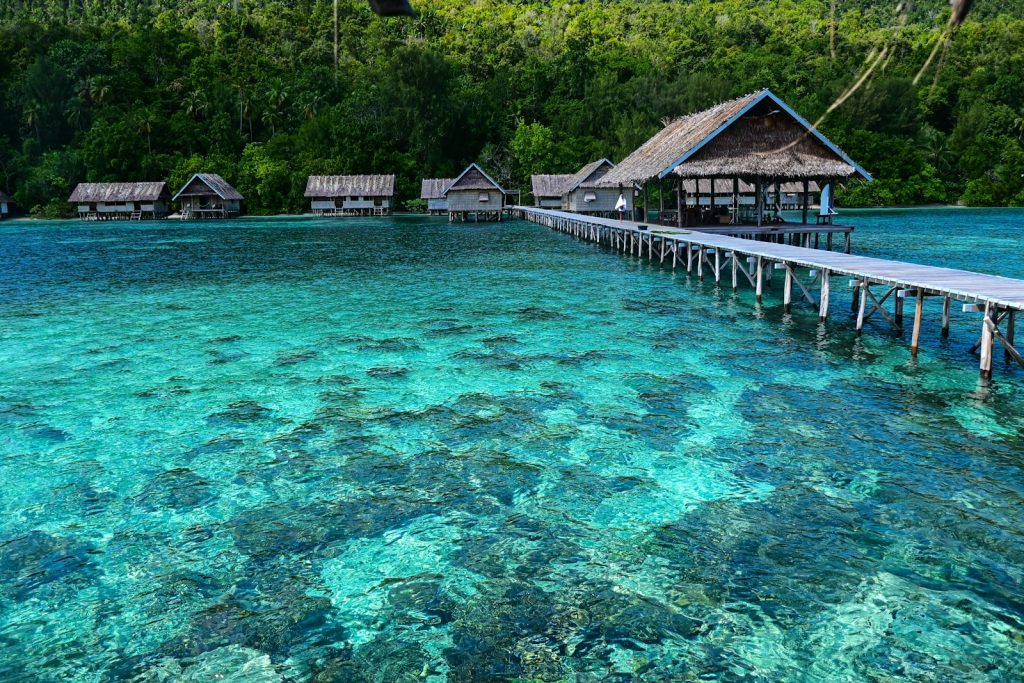
“Derawan Island Resort” is not one single property but a loose cluster of small derawan dive resort-style stays, overwater and derawan beach bungalows, and family homestays around Derawan village. Most are Indonesian-owned, modest in scale, and focused on turtles, snorkeling and relaxed island life more than high-end luxury.
There is no large, international-branded resort on Derawan. Instead, expect:
- Simple, often overwater or seafront rooms on stilts
- A jetty or house reef with frequent turtle sightings
- Shared dining pavilions with set meals
- A casual, village-island atmosphere with warungs and small shops
If you want a village base with easy access, Derawan is the first island to consider in the archipelago; if you want more seclusion and big-wall diving, Maratua is often better.
Why stay on Derawan Island?
Easiest access in the Derawan archipelago
Derawan is the easiest island to reach in the Maratua–Derawan–Kakaban–Sangalaki group.
The standard route (last verified June 2026):
- Fly to Berau (Kalimarau Airport), typically via Balikpapan
- Drive about 2–2.5 hours to Tanjung Batu jetty
- Take a speedboat 30–40 minutes across to Derawan Island, depending on sea state and boat
Compared with Maratua, Derawan usually means:
- Shorter boat transfer
- More frequent public / shared-boat options
- Greater flexibility for late arrivals or weather delays
If you want the least complex logistics or are traveling with young children, Derawan is usually the gentlest introduction to the archipelago.
Resident green turtles just offshore
Derawan is known for its resident green turtles that graze and rest in the seagrass and shallows around the island. You can often:
- Snorkel from the main jetties and see multiple turtles in a single session
- Spot turtles surfacing from the beach at high tide
- Watch them navigate the village harbor area early and late in the day
Nothing is guaranteed, but compared with Maratua and Sangalaki, Derawan is the most consistent for easy, frequent turtle encounters within a few fin kicks of shore. It is one of the main reasons many guests choose a derawan dive resort or beach bungalow here rather than a more remote base.
Village-island atmosphere
Derawan is a real, lived-in island village, not a private-resort island. Expect:
- A dense, walkable grid of sandy lanes and wooden houses
- Mosques, schools and small groceries
- Simple warungs and snack stalls
- Children cycling and playing along the beach
Staying here feels more social and grounded than on quieter Maratua cove resorts. You trade a degree of seclusion for:
- More food choices beyond your resort
- Small conveniences (ATMs are unreliable; carry cash from the mainland)
- Easy access to local boatmen and guides
If you prefer a sense of local life and don’t mind the soundscape of village mosques, scooters and roosters, Derawan can be the right fit.
Derawan accommodation formats: which suits you?
Most derawan island resort options fall into three broad types. Names and ownership shifts over time, but the formats stay consistent.
1. Derawan beach bungalow & overwater bungalows
These are the classic “Derawan stay” most people picture: simple wooden rooms on stilts over the water or right at the beach fringe.
Typical features:
- Fan or air-conditioning (AC varies by property and room category)
- Private en-suite bathroom (often wet-room style; hot water may be by heater unit)
- Small terrace or verandah over the lagoon or facing the beach
- House reef or jetty ladder directly into the water
Expect these bungalows to be:
- Rustic rather than polished: think painted plywood, basic furnishings, and occasional creaks
- Focused on location: sunrise / sunset views and turtles below the jetty rather than high design
- Most comfortable in AC categories; fan-only rooms can feel warm in still conditions
Ideal for:
- Snorkelers who want to be in the water before breakfast
- Couples and small groups seeking a private-feeling base but happy with simple comforts
- Photographers wanting overwater sunrise/sunset scenes
2. Small derawan dive resort operations
A few properties function more explicitly as “derawan dive resort” style bases, with an in-house dive center, gear storage, and daily boat diving.
These are still small-scale by global standards. Common traits:
- Room stock usually under 20–25 units
- Simple, functional rooms overwater or onshore
- Central dining hall with full-board (3 meals) the norm
- Dive center on-site or arranged with a close neighbor
- Daily dive boat departures for sites around Derawan, occasionally to Sangalaki / Kakaban (surcharges apply, especially for private or small-party trips)
They are best suited to:
- Certified divers who want structured dive days
- Traveling dive clubs or small groups who want to charter a boat for several days
- Guests who prioritize dive logistics over high-end facilities
If your priority is serious Maratua-channel, big-wall and pelagic diving, a dedicated Maratua dive resort is usually more efficient. But Derawan-based diving can work well as:
- Mixed snorkel/dive trips (kids or non-divers in the party)
- Short trips where you do not want a second long boat transfer
- Turtle- and macro-focused itineraries, with occasional longer runs to manta or jellyfish lakes if weather and budgets align
3. Local homestays & guesthouses
Homestays are scattered through the village lanes and along seafront boardwalks. Standards vary widely, but generally:
- Rooms are simple, fan-cooled; some now offer AC
- Bathrooms can be shared or private, often mandi-style (bucket showers)
- Meals may be included or available on request, or you eat in local warungs
- No in-house dive operation; you join local boats or organize diving via a partner resort
Good for:
- Budget travelers and backpackers
- Culturally curious guests who want host interaction
- Guests who don’t need a private jetty or house reef on their doorstep
Less suitable if:
- You require guaranteed quiet and privacy
- You are traveling with heavy camera gear and need secure, dry storage
- You expect hotel-style service or English-speaking staff
Derawan vs Maratua: which is the better base?
Both Derawan and Maratua make excellent bases in the archipelago, but they feel very different. Below is a simplified comparison.
- Access
- Derawan: Shorter boat transfer from Tanjung Batu; more shared options. Maratua: Longer open-water run (commonly 60–90 minutes); typically private or resort-arranged transfers.
- Atmosphere
- Derawan: Busy village island; social, more local life. Maratua: Quieter, more spread-out coves and resorts.
- House reef & turtles
- Derawan: Consistent turtles near jetties; easy snorkeling. Maratua: Often stronger currents and walls; excellent diving but not as “walk-off-the-jetty” turtle-centric.
- Diving focus
- Derawan: Mixed snorkel/dive, turtles, some macro. Maratua: Channel and wall dives, schooling fish, pelagic encounters (conditions-dependent).
- Island-hopping logistics
- Both can arrange trips to Kakaban & Sangalaki. Derawan often acts as a convenient “launch point” with more local boat options; Maratua trips can be longer but closer to some offshore sites.
- Quiet & seclusion
- Derawan: More noise (mosques, boats, village life). Maratua: Quieter nights at most resort coves.
- Costs
- Derawan: Wider range, from budget homestays to mid-range bungalows. Maratua: Generally higher-per-night for equivalent comfort, due to remoteness.
If you are unsure which to choose as your main base, see our dedicated comparison page: Maratua vs Derawan.
What’s near Derawan: turtles, snorkeling & island-hopping
Everyday Derawan turtle snorkeling
Derawan’s hallmark experience is straightforward: mask on, step off the jetty, and look for turtles. You do not need to be an advanced swimmer.
Common patterns:
- Turtles graze and rest around piers, ropes and seagrass beds
- Early morning and late afternoon often feel more active and less boaty
- Visibility ranges from milky to clear, depending on tide, wind and recent rain
For detail on where and how, see our dedicated guide: Derawan turtle snorkeling.
As always: do not touch, chase or block surfacing turtles. Stay horizontal and give them a clear escape route.
Reefs and snorkel spots around Derawan
Close-boat snorkel spots often visited from Derawan include:
- Patch reefs and drop-offs a short ride from the village
- Gentle coral gardens in more sheltered corners
- Occasional drift snorkels where currents allow
Conditions:
- Snorkeling is generally tide- and weather-dependent; your operator will advise daily
- Coral health is mixed: pockets of vibrant growth with some areas impacted by past pressure and climate
If you are primarily a snorkeler, Derawan’s combination of near-house-reef turtles and short-run boat sites makes logistics easy.
Island-hopping: Kakaban, Sangalaki & beyond
Derawan is one of the main launch points for day trips to:
- Kakaban: famous for its non-stinging jellyfish lake and surrounding walls
- Sangalaki: known historically for manta encounters, plus turtles and reefs
Expect:
- Early morning departure (often after breakfast; exact time tide- and operator-dependent)
- 1–2 hours travel each way, variable by sea conditions and the boat you use
- Park fees, fuel surcharges and site tickets as add-ons
Trips can be:
- Private (more expensive but flexible)
- Group/shared (cheaper; fixed schedule; often organized by your stay or local boats)
For more on underwater sites, see Derawan diving.
Typical inclusions and add-ons in Derawan stays
Because there is no single “Derawan Island Resort” brand, inclusions vary by property. These patterns are based on current norms (last verified June 2026) and are general, not property-specific.
What’s usually included
Most derawan beach bungalow and derawan dive resort packages will typically include:
- Accommodation in your chosen room category
- Full-board meals (breakfast, lunch, dinner) or half-board at some village stays
- Drinking water, tea and local coffee at meal times
- Basic daily housekeeping (towels changed on request)
- Use of house jetty or entry point for snorkeling
Some packages also include:
- Shared land/sea transfers from Tanjung Batu or Berau (check distance, conditions and timing)
- Simple sunset or short snorkeling outings around the island
We maintain summary notes on inclusions across the archipelago; for broader context see: What is included in Derawan & Maratua stays.
What’s usually extra
Expect the following to be add-ons, not automatically bundled:
- Speedboat transfers, especially private transfers outside standard slots
- Diving: per-dive, per-day or per-package pricing, plus gear rental
- Island-hopping day trips (Kakaban, Sangalaki, Maratua runs)
- Marine park / conservation fees and site entry tickets
- Drinks beyond water/tea/coffee (soft drinks, coconuts, juices, beer where available)
- Guided night snorkeling or special turtle-watching programmes
- Laundry, tips and any conservation donations
Some derawan dive resort packages will bundle a fixed number of dives for a minimum stay, but fuel surcharges for remote sites can still apply.
Electricity, water and comfort basics
- Power: 24-hour electricity is now common in many properties, but some may have generator-based schedules or occasional outages
- Water: Freshwater is limited; showers are often brackish-mix. Expect basic water pressure, not hotel-style rain showers
- Internet: 4G coverage has improved, but speeds are inconsistent; many guests hotspot via Indonesian SIM rather than relying on resort Wi-Fi
- Mosquitoes: Present, especially at dusk; bring repellent and light cover
If constant high-pressure hot water and strong Wi-Fi are non-negotiable, you will need to calibrate expectations or consider alternatives.
Indicative price ranges (by quote, not fixed)
Derawan pricing changes with season, fuel, currency and exact inclusions. We do not publish exact rates for any one property; all stays are quoted case-by-case via our vetted partner. Ranges below are indicative only (last verified June 2026) and assume 2 adults sharing, per room per night, including at least breakfast and often full-board.
Budget: homestays & simple guesthouses
- Approx. IDR 300,000 – 700,000 per room per night
- Usually fan rooms; AC at the upper end of the range
- Simple breakfast; other meals in warungs or on request
Works if:
- You prioritize cost over comfort
- You are comfortable with mandi-style bathrooms and basic bedding
Mid-range: derawan beach bungalow & small dive resorts
- Approx. IDR 900,000 – 2,300,000 per room per night
- Typically includes full-board meals in many packages
- Mix of fan and AC; seafront or overwater likely in higher subranges
This is where most derawan island resort-style stays fall. The spread reflects:
- Room type (garden vs seafront vs overwater)
- Season and occupancy
- Any bundled transfers or activities
Upper mid-range: best-sited overwater units & tailored packages
- Approx. IDR 2,400,000 – 4,000,000+ per room per night
- Often the premium overwater or corner units with best views
- Packages may include some transfers, guiding or initial dives/snorkels
Beyond this, trip totals escalate mostly via:
- Private speedboat use
- Multiple long-range day trips (Kakaban, Sangalaki, Maratua channel)
- Frequent diving with full gear rental for several days
All detailed pricing is by quote. For a tailored figure for your dates and priorities, you can plan your trip with our partner via email or WhatsApp.
How booking works: our role & our vetted partner
Maratua Resort (this site) is an independent, editorial guide-and-concierge across the Derawan archipelago. We are not a resort operator or boat owner, and we do not manage any single “Derawan Island Resort”.
Our role:
- Help you choose the right base: Derawan vs Maratua vs a split stay
- Clarify which derawan beach bungalow or derawan dive resort format suits your group
- Sense-check itineraries and trade-offs (e.g. fewer bases vs more island-hopping)
- Route your serious enquiry to one vetted on-the-ground partner who actually runs the logistics
Important for transparency:
- Properties mentioned on this page are described only as neutral examples of formats; we are not “pushing” one named resort over another
- No one can pay to change what we publish; if you proceed with our partner they may pay us a referral fee at no extra cost to you
To start a tailored plan, you can email sales@komodoluxury.com or WhatsApp +62 811 3823 875 and say you are planning a Derawan trip via Maratua Resort. Or, if you prefer a simple form, you can plan your trip here and they will follow up by email or WhatsApp.
How long to stay on Derawan, and sample patterns
Stay length
Common stay lengths:
- 3 nights: Enough for local turtle snorkeling and a taste of island life; island-hopping feels rushed
- 4–5 nights: More balanced; allows one or two full-day trips to Kakaban/Sangalaki
- 6–8 nights: Good for mixed snorkel/dive trips, with several relaxed “no-boat” days
If you are also staying on Maratua, many guests split:
- 3–4 nights Derawan + 4–5 nights Maratua
- Derawan first (for simpler arrival), then Maratua for more remote walls and channels
Trip patterns by traveler type
These are pattern examples, not fixed packages.
- Snorkel-focused couple:
- 4 nights Derawan base
- 1 full-day trip to Kakaban jellyfish lake
- 1 full-day trip to Sangalaki (conditions permitting)
-
1–2 relaxed Derawan-only days with house-reef snorkeling
-
Dive-oriented pair with some snorkeling:
- 2–3 days of local Derawan diving (2–3 dives/day)
- 1 Kakaban + nearby reef walls day (conditions permitting)
-
1 relaxed day for village wandering, no fixed boat
-
Family with children:
- 4–5 nights Derawan
- Mostly near-shore snorkeling and sand-time
- Possibly a single, shorter island-hopping day if kids are boat-tolerant
A WhatsApp conversation with our partner is usually the fastest way to calibrate what is realistic for your group and season; you can plan your trip and request WhatsApp-first planning if preferred.
Conservation-minded travel on Derawan
Derawan’s appeal—resident turtles, accessible snorkel sites, village culture—also makes it vulnerable. A few simple choices help reduce your impact:
- Use reef-safe sunscreen (or long-sleeve rashguards) to limit chemical load
- Do not stand on coral or hold onto living structures, even in shallow water
- Give turtles and rays clear space; observe, do not chase
- Minimize single-use plastics; carry a refillable bottle and use drinking-water stations
- Respect local norms: modest dress in village lanes, especially away from the beach
Some operators and local groups support turtle monitoring and reef clean-ups. If you are interested in participating or contributing, our partner can outline low-friction options.
Planning your Derawan stay with an editor’s eye
A few final angles to sanity-check as you choose your derawan island resort base:
- Noise tolerance: Village calls to prayer and boat engines are part of Derawan; if you are sensitive, ask for rooms away from main jetties and loudspeakers
- Mobility: Overwater bungalows often mean uneven planks and steps; if anyone in your group has reduced mobility, mention this upfront
- Children: Many stays are family-friendly in an informal way, but few have formal kids’ clubs. Focus instead on simple, safe access to shallow water and shade
- Season and sea state: Wind and swell affect island-hopping plans; build at least one “buffer day” into trips that hinge on Kakaban or Sangalaki
If you would like an honest opinion on where to stay in Derawan given your travel style, message sales@komodoluxury.com or WhatsApp +62 811 3823 875 and mention Maratua Resort, or plan your trip and we’ll route you to our partner with notes attached.
FAQs: Derawan Island Resort & stays
Is Derawan or Maratua better for a first-time visit?
For a first-timer prioritizing easy logistics and turtle snorkeling, Derawan is usually the better starting point. Access is simpler, village services are more varied, and the odds of seeing turtles right from jetties are high. If you are a certified diver focused on channels and walls, Maratua often makes more sense as at least part of your stay. Many travelers combine both.
Can I visit Kakaban and Sangalaki on day trips from Derawan?
Yes. Derawan is a common launch point for full-day trips to Kakaban’s jellyfish lake and to Sangalaki. Boat travel times are typically around 1–2 hours each way, depending on sea conditions and boat type. Trips are weather- and tide-dependent and usually charged as extras with separate park fees.
Are Derawan island resorts suitable for non-divers?
Very much so. Most guests on Derawan snorkel more than they dive. House-reef turtle snorkeling, gentle beach shallows, village walks and occasional island-hopping days are enough to fill 3–5 nights comfortably. Non-divers can join many boat trips as snorkelers while divers drop onto deeper sites nearby.
How far in advance should I book a Derawan beach bungalow?
For peak Indonesian and regional holidays, aim for 3–6 months ahead, especially if you want specific overwater units or connecting rooms. Outside peak periods, 1–3 months is often sufficient, but boat schedules and connecting flights can still fill. Last-minute is sometimes possible but offers less choice and can complicate transfers.
How do I actually book a Derawan stay through this site?
You browse our neutral guides, decide roughly where you’d like to base yourself, then email sales@komodoluxury.com or WhatsApp +62 811 3823 875, or use our plan your trip form. We pass your details and preferences to one vetted local partner, who proposes specific resorts, boat plans and pricing. If you confirm, you pay them directly; they may pay us a referral fee at no extra cost to you.