How to read this: Maratua Resort is an independent concierge guide — we curate and compare dive resorts and island stays in the Derawan archipelago, then arrange your booking through a vetted operating partner. We do not own or operate the resorts, and resort or brand names are used only as neutral examples, not claims of affiliation. Prices are by quote and vary by resort, season and party; figures here are indicative. Flights, transfers and dive seasons change — confirm before you travel. This is general information, not a binding offer.
Maratua vs Derawan where to stay is essentially a choice between a remote atoll with overwater bungalows and steep walls, or an easy-access village island with turtles and cheaper rooms. If you have 5–10 nights in the Derawan archipelago, most divers do best either basing on Maratua and day-tripping, or splitting their time between both islands.
The core trade-off: remote atoll vs easy-access village
In simple terms: choose Maratua if you want an atoll-edge dive-resort feel with jetties, walls and relative quiet; choose Derawan if you prioritise ease of access, lower budgets, village atmosphere and turtles off the beach. That is the heart of the maratua or derawan decision.
Both islands sit in East Kalimantan’s Derawan archipelago and are usually reached via the same mainland jetty at Tanjung Batu. From there, fast boats run out across the lagoon: Derawan first (shorter, cheaper), then further to Maratua on the outer atoll rim (longer, more expensive, more weather-dependent).
From a diver’s perspective, you can reach many of the marquee sites — Kakaban’s Barracuda Point, Sangalaki’s manta cleaning stations — from either island, via day boats. The difference is the daily journey length and the feel of your base. From a non-diver’s perspective, the decision shifts even more strongly towards the kind of stay you want between dives or snorkels:
- Maratua: quiet, more “resort” than “village”. Overwater bungalows are here, not on Derawan. You sleep over a lagoon, often with house-reef drop-offs a few fin-kicks from your steps.
- Derawan: lived-in island, with a village, homestays and simpler resorts along the shore. Easy to walk around, buy snacks, people-watch, and snorkel with resident green turtles right off the jetty.
From our experience and guest feedback, the most common patterns are:
- All Maratua (usually 5–7 nights) for keen divers and couples who want an atoll-resort atmosphere.
- All Derawan (usually 3–5 nights) for shorter trips, tighter budgets, or travellers who want more of an island-village feel.
- Split stay (e.g. 3 nights Derawan + 4–5 nights Maratua) for people unsure which island in the Derawan archipelago suits them best and who have a week or more.
This page compares the islands as neutrally as possible. We do not operate any resort or boat; we curate, compare and route enquiries to a vetted local partner. No one can pay to change what we publish; if you proceed with our partner they may pay us a referral fee at no extra cost to you.
Maratua’s case: why base on the atoll edge
Maratua is the large, horseshoe-shaped atoll on the outer edge of the Derawan archipelago, with its lagoon opening southwards. Most dive resorts sit on the eastern rim, looking straight out to deep water. This geography shapes almost everything about a Maratua stay: the diving, the seascape, the quiet.
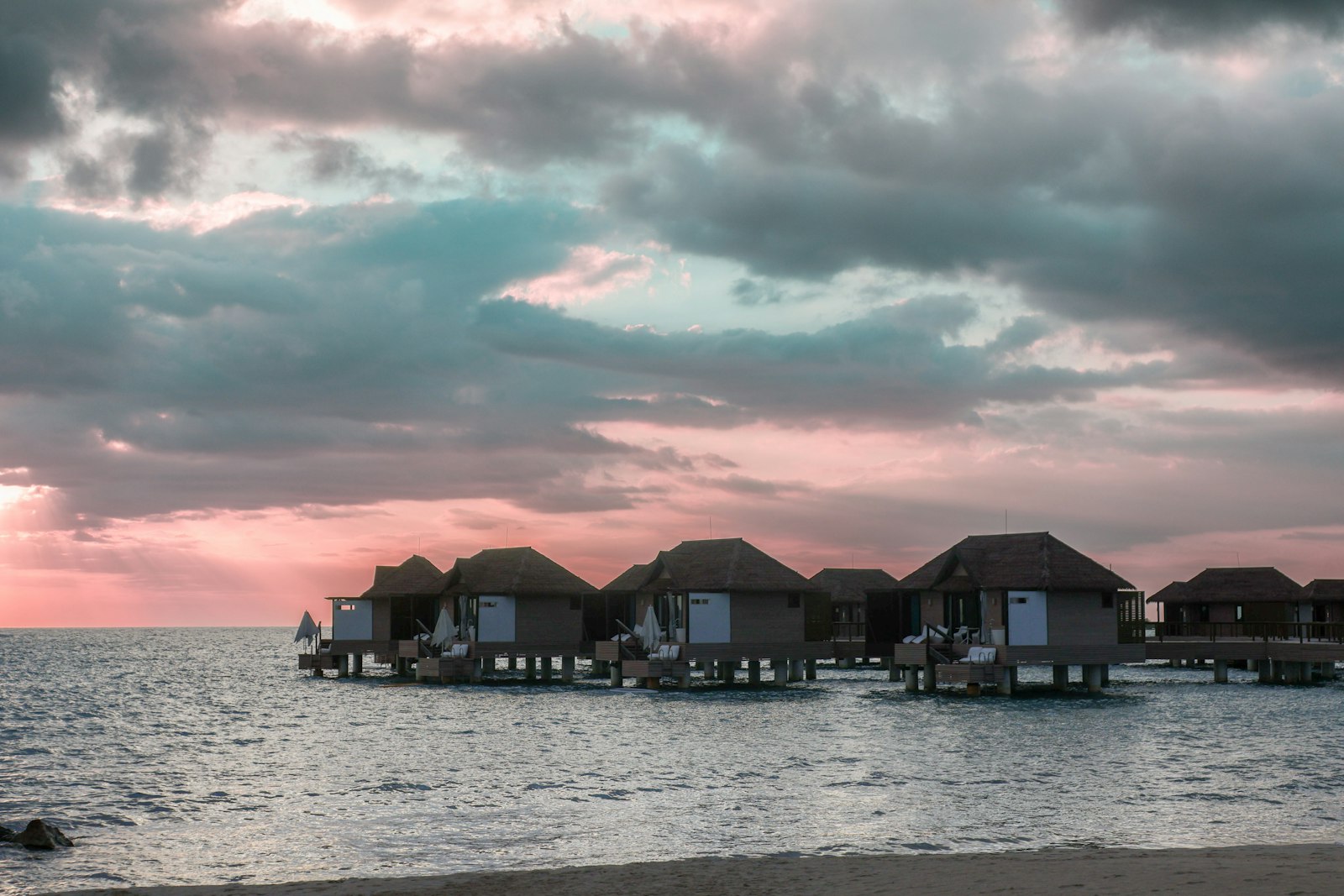
Overwater bungalows in the Derawan archipelago
If you imagine waking up in an overwater bungalow with the sea under your floorboards, you are imagining Maratua, not Derawan. Several resorts here have long jetties with rooms built on stilts over the lagoon; others have villas close enough that you walk from bed to house-reef in minutes.
We go into detail on specific layouts and entry-level room types in our dedicated page on overwater bungalows in Maratua, but the key editorial points are:
- Sense of separation: overwater rooms usually sit at the far end of a jetty, with more privacy and constant horizon views.
- Direct sea access: most have some form of private or semi-private ladder into shallow lagoon water (tidal and weather dependent).
- Price premium: overwater categories often command the highest nightly rates on the atoll (ranges vary; last verified June 2026).
If an overwater bungalow is non-negotiable, the “Derawan vs Maratua base” decision is immediately skewed towards Maratua.
Maratua’s walls, channels and schooling fish
Dive-wise, Maratua’s home turf is its atoll walls and channels. You are closer here to:
- Maratua’s outer walls: sheer drop-offs where currents can bring in schooling barracuda, trevally and fusiliers, with turtles and reef sharks as regulars.
- Channel and “big fish” sites: depending on season and operator, some sites known for schooling barracuda and occasional pelagics are easier to reach from Maratua than from Derawan.
- House-reef dives: several resorts have house-reefs with drop-offs or coral slopes accessible from their jetty. These are ideal for an easy afternoon dive or long critter-focused night dive.
We avoid promising specific species; currents, seasons and luck all matter. But if your priority is walls, blue water and a chance of schooling fish from your doorstep, Maratua offers the strongest case as your base.
For a deeper breakdown of dive sites and how each resort uses them, see our Maratua dive resort guide.
Quieter, more “resort” than “village”
Maratua’s eastern rim has modest infrastructure. Outside the resort clusters, the island is largely forested or village farmland. That makes the atoll feel distinctly more remote than Derawan.
- Soundscape: you are more likely to hear waves, wind and the occasional scooter or mosque call than a busy village.
- After-dive life: expect quiet decks, early nights, and socialising mainly within your resort. Bars and independent cafés are limited.
- Light pollution: generally lower than Derawan, which can make for good starry nights and bioluminescence on very dark evenings.
Some travellers find this blissful; others feel “stuck at the resort”. If you enjoy simple, early-to-bed dive routines, Maratua supports that rhythm well.
Costs: usually higher, but still relatively good value
Based on our June 2026 checks, typical patterns are:
- Accommodation: Maratua’s overwater and seafront rooms generally sit above Derawan’s guesthouses and small resorts on a per-night basis, though still below top-tier Indonesian liveaboard pricing.
- Dive packages: multi-day dive-and-stay bundles can represent reasonable value compared to booking all dives à la carte.
- Transfers: boat transfers to Maratua are longer and therefore usually more expensive than to Derawan.
If your budget is constrained, this may tilt your “best island to stay Derawan” calculation away from an all-Maratua trip and towards a split stay or a Derawan base with day-trips outward.
Derawan’s case: access, turtles and a village island feel
Derawan Island is the easiest stepping-stone into the archipelago and the most lived-in. Its shoreline is a mix of modest resorts, homestays, jetty cafés and local homes; its shallow waters shelter a reliable population of green turtles grazing and rising to breathe.
Easiest access in the archipelago
If your priority is a low-friction arrival, Derawan clearly wins the maratua or derawan choice.
- Shorter transfer from Tanjung Batu: the boat leg to Derawan is noticeably shorter than continuing to Maratua. In practice this means lower boat costs and less exposure to bumpy seas in rougher weather.
- More frequent boats: because Derawan is closer and more trafficked, seats on boats (shared or chartered) are usually easier to arrange, especially for short stays.
- Useful for late arrivals: if your flight into Berau lands late, many travellers overnight on Derawan first; a transfer to Maratua in marginal light or weather is not always possible or desirable.
If you are the sort of traveller who dreads long boat rides, Derawan’s convenience has real value.
Green turtles right off the beach
Derawan’s resident green turtles are, for many, the island’s highlight. In calm conditions it is often possible to snorkel with turtles off the jetty at high tide, or to watch them cruise past from a wooden walkway.
A few important caveats:
- No guarantee: they are wild; there is no fixed timetable.
- Ethical distance: good guides will insist on no touching, no chasing, and calm, horizontal approaches.
- Light and tide dependent: visibility, time of day and tides all affect how clearly you will see them.
Still, if you are travelling with non-divers or children, Derawan’s easy-access turtle encounters make it a very strong “first island” choice.
Village vibe and everyday life
Derawan feels like a real Indonesian island village that happens to host dive tourism, rather than a pure resort enclave. That means:
- More independent food options: local warung-style places, simple seafood eateries and snack stalls, alongside resort dining rooms.
- Shops and services: small minimarts, phone-credit kiosks and casual cafés along the main walkways.
- Island walks: you can wander the lanes, watch kids playing, see everyday domestic and fishing life.
For some travellers, this makes Derawan the best island to stay in the Derawan archipelago, especially for a first visit or for those who prize atmosphere over absolute remoteness.
More budget flexibility
Derawan offers a wider spread of price points. Based on our June 2026 survey:
- Homestays and simple guesthouses can be significantly cheaper per night than Maratua’s resort rooms.
- Mid-range island resorts still generally undercut equivalent room categories on Maratua.
- Diving: individual fun-dive prices are in a similar band to Maratua, but overall trip costs are often lower thanks to cheaper rooms and transfers.
For backpackers, solo travellers, or groups watching per-person spend closely, Derawan’s financial flexibility is hard to ignore.
Diving and snorkelling from Derawan
While Derawan’s immediate house-reef is shallow and seagrassy in parts, its main value as a base is its centrality for day trips:
- Turtle-focused snorkelling: very easy off the shore and jetties in calm conditions.
- Access to Kakaban & Sangalaki: many local operators run day boats to the main archipelago highlights, especially for snorkellers.
- Reef dives: nearby reefs and coral gardens can be reached by small boats; serious divers may prefer to combine with Maratua for deeper walls and channels.
You will find more detail and neutral operator comparisons on our dedicated Derawan Island resort page.
Access and transfer differences
Understanding how you actually reach each island helps make sense of the Derawan vs Maratua base choice.
The common starting point: Berau and Tanjung Batu jetty
Most travellers fly into Berau (Kalimaru) airport, then travel by road to Tanjung Batu jetty and by boat to the islands. The exact timings and costs vary with operator, boat type and weather, but editorially the key points are:
- Same road for both: the land transfer to Tanjung Batu is identical regardless of whether your final base is Derawan or Maratua.
- Boat leg differs: the sea segment is shorter to Derawan, longer to Maratua; any sea-state discomfort is therefore amplified on a Maratua transfer.
- Shared vs private boats: some resorts and agents consolidate guests into shared speedboats; others arrange private charters. Both islands see both models.
From a comfort and cost perspective, Derawan is easier; from a “feels far away” perspective, Maratua’s extra distance is part of the appeal.
Weather sensitivity
All open-boat transfers are weather-dependent. In rougher conditions:
- Derawan remains more reachable: the shorter distance and partial shelter of the inner archipelago make cancellations or delays less likely, though still possible.
- Maratua plans may flex: in heavy sea-states, operators may delay or reschedule transfers to/from the atoll rim.
This is another reason some travellers choose to land on Derawan first: if seas are marginal, you have a comfortable base to wait rather than a rushed or bumpy crossing.
Day-trip distances to other islands
From a base perspective, you should also consider how far you will travel for marquee day trips:
- From Maratua
- Closer to Kakaban’s outer walls and some big-fish channels; day trips to Sangalaki are feasible but can be longer.
- From Derawan
- Central for mixed snorkel/diver trips to Kakaban (including the jellyfish lake) and Sangalaki; further from Maratua’s outer walls.
If your dream is to maximise atoll dives (walls, channels), Maratua saves boat time. If you are more jellyfish-lake and manta-focused, either can work, with Derawan sometimes favoured for shorter mixed-activity days.
If you need help mapping these distances against your exact dates and priorities, you can plan your trip with us; we are happy to sketch realistic transfer and day-trip options over WhatsApp at +62 811 3823 875.
Splitting your stay: Maratua and Derawan in one trip
For travellers with 7–12 nights in the region, the most balanced answer to “Maratua vs Derawan where to stay” is often: both. A split stay lets you sample the turtles and village of Derawan and the walls and overwater bungalows of Maratua.
Common split patterns
What we most often see, editorially:
- 3 nights Derawan + 5–7 nights Maratua
Fly in, transfer to Derawan for turtles and village wandering; then continue to Maratua for deeper diving and more seclusion. - 4–5 nights Maratua + 2–3 nights Derawan
Start at the atoll for full days of diving, then decompress on Derawan before flying out, with easier logistics if the weather turns. - Shorter trips (5–6 nights total)
Choose one island as your main base and add 1–2 nights on the other only if transfers align cleanly with flights.
Pros of a split stay
- Variety: you experience both a resort and a village environment, and a wider mix of dive/snorkel sites.
- Budget smoothing: you can offset pricey overwater nights on Maratua with simpler rooms on Derawan.
- Weather hedge: if seas get rough, you are not betting everything on a single long transfer window.
Cons and considerations
- Transfer overhead: extra boat crossings, packing/unpacking and check-in/out time.
- Dive planning complexity: you need to coordinate no-fly times, deep-dive days and boat schedules across two bases.
- Minimum-night policies: some resorts on Maratua prefer or require a minimum number of nights in their packages; this may limit very short splits.
If you have fewer than 6 nights total, we generally suggest choosing a single base rather than fragmenting your time. With a week or more, a split becomes attractive, especially for couples or small groups balancing different budgets and preferences.
Who each island suits: quick profiles
Below is an at-a-glance comparison to help you decide which island in the Derawan archipelago matches your style of travel.
| Profile / Priority | Maratua | Derawan |
|---|---|---|
| Overwater bungalows | Yes – primary location for overwater bungalow Maratua stays. | No overwater resorts; mostly shore-based rooms and homestays. |
| Access & transfer ease | Longer, more weather-sensitive boat transfer. | Shorter, cheaper, typically easier boat transfer. |
| Budget flexibility | Generally higher nightly rates; more resort-style pricing. | Wider budget range from homestays to mid-range resorts. |
| Village life & local food | Quieter; limited outside-resort options. | Active village, warungs, small shops and cafés. |
| Dive focus: walls & channels | Strong – atoll walls and blue-water sites nearby. | Possible via longer day boat rides. |
| Snorkelling with turtles off the beach | House-reef snorkelling depends on specific resort. | Consistent turtle encounters near jetties in calm conditions. |
| Non-diver friendliness | Relaxation, overwater lounging, limited independent exploring. | Easy walks, village watching, casual snorkelling and cafés. |
| “Remote island resort” feel | Strong – especially at overwater-focused properties. | Milder – more activity, more boats, more people. |
If you prioritise diving first
For serious divers willing to invest in a more remote base, Maratua usually edges ahead:
- Base on Maratua if you want daily access to atoll walls and channels, plus a decent house-reef.
- Add Derawan if you want to fold in easy turtle snorkels and a softer landing/logistics.
Your exact choice of Maratua dive resort will determine how many dives per day, how far they routinely boat out, and whether night dives are common. Our resort editorials on Maratua dive resort options compare this in more detail.
If you prioritise budget and simplicity
- Base on Derawan to keep transfer costs down and choose from a wider range of rooms.
- Book targeted day trips to Kakaban, Sangalaki and, if you wish, a day on Maratua’s reefs.
This pattern suits solo travellers, backpackers and groups mixing divers with non-divers whose main priorities are turtles, warm water and an easy rhythm, rather than maximising wall dives.
If you care most about atmosphere
- Choose Maratua if your dream is coffee on an overwater deck, long quiet evenings and feeling removed from the world.
- Choose Derawan if you want to wander, snack-hop, and watch island life unfold between swims.
Neither island is built-up in the way of Bali or resort-heavy parts of Sabah; the distinction is relative, not absolute.
How we can help you choose your base
Maratua Resort (the site you are reading) is an independent editorial guide, not a single-resort booking engine. We compare islands and resorts neutrally across the Derawan archipelago, then route serious trip plans to a vetted, on-the-ground partner who actually operates boats and rooms.
Our recommendations are opinionated but not for sale: no one can pay to change what we publish; if you proceed with our partner they may pay us a referral fee at no extra cost to you. That model lets us give straight advice on themes like “Maratua vs Derawan where to stay” without having to push you towards one specific property.
If you would like tailored suggestions based on your dates, budget band and interests (macro vs big fish, divers vs snorkellers, non-divers in the group), you can plan your trip with us. A human coordinator will follow up, often via WhatsApp on +62 811 3823 875, to help you make the call.
FAQs: Maratua vs Derawan
Is Maratua or Derawan better for first-time visitors?
For a very short trip (3–4 nights), Derawan is usually more forgiving: transfers are easier, budget options are broader, and you can snorkel with turtles almost immediately. For a week or more, many first-time visitors prefer to split their stay, starting on Derawan and finishing with an overwater or atoll-focused stay on Maratua.
Which island is better for non-divers?
Derawan generally suits non-divers better, thanks to easy turtle snorkelling, village walks, simple cafés and people-watching. Maratua works well for non-divers who mainly want quiet time on decks, lagoon swims and a resort feel, especially in overwater bungalows, but offers less independent wandering.
Can I do day trips between Maratua and Derawan?
Yes, in principle. Operators sometimes run cross-island trips or multi-stop itineraries that link Derawan, Kakaban, Sangalaki and Maratua. However, these can be long days at sea and are weather-dependent. If you know you want significant time on both islands, a structured split stay is usually more relaxed than relying on spontaneous day trips.
Is diving noticeably better on Maratua than on Derawan?
The character of the diving is different rather than universally “better”. From Maratua you have quicker access to atoll walls and channels, which many experienced divers prefer. From Derawan you have easier access to turtle-rich shallows and convenient day trips to sites like Kakaban and Sangalaki. Serious divers often favour Maratua as a base, then add Derawan nights for variety.
How far in advance should I book Maratua or Derawan?
For peak periods and overwater bungalows on Maratua, booking several months ahead is sensible, especially for couples and small groups. Derawan’s broader room stock gives more last-minute flexibility, but specific properties can still fill up around holidays. If your dates aren’t flexible, it is wise to start planning early; you can plan your trip with our team or message WhatsApp +62 811 3823 875 to check realistic options.